


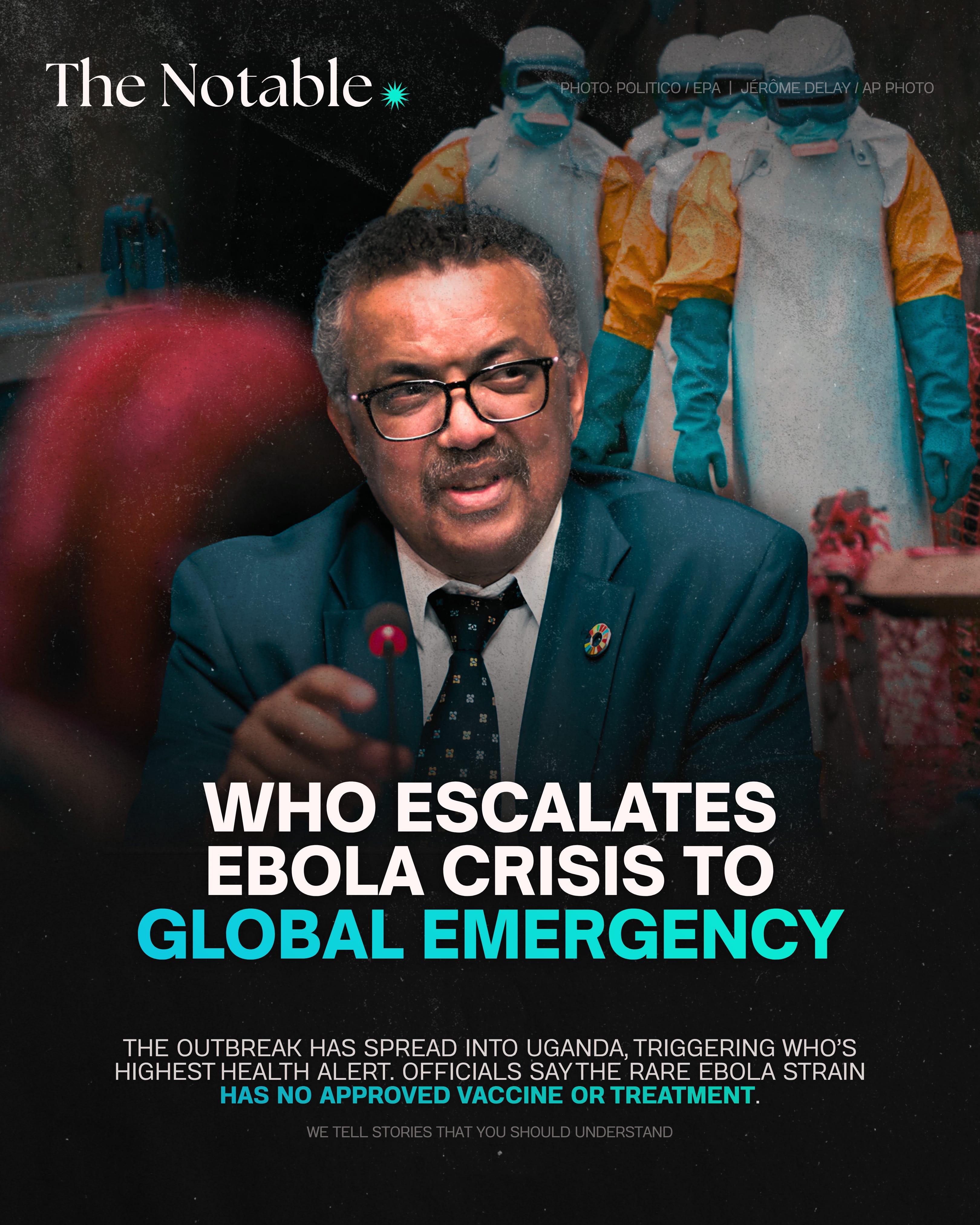
The World Health Organization has declared a global health emergency after a deadly Ebola outbreak spread from eastern Democratic Republic of the Congo into neighboring Uganda, escalating fears of a wider regional crisis.
The declaration marks the highest international health alert WHO can issue short of a pandemic classification. It comes as health officials race to contain a rare strain of Ebola that currently has no approved vaccine or targeted treatment.
The outbreak is already being described as one of the most concerning Ebola emergencies in years, not only because the virus crossed an international border, but because it emerged in one of the most unstable regions in Africa.
A Rare Ebola Strain With No Approved Vaccine
The outbreak is being caused by the Bundibugyo strain of Ebola, one of the rarest known forms of the virus.
That detail is critical.
Unlike previous major Ebola outbreaks involving the Zaire strain, existing Ebola vaccines were not designed for Bundibugyo. Officials say there are currently no approved vaccines or targeted therapies specifically developed for this variant.
That leaves public health authorities relying on traditional containment methods:
isolation
contact tracing
border surveillance
emergency testing
community monitoring
In other words, containment now depends heavily on speed, coordination, and public cooperation rather than pharmaceutical protection.
How The Outbreak Began
Health workers in eastern Congo’s Ituri Province first began reporting clusters of unexplained illness and deaths in late April.
The affected region includes areas near the Ugandan border, where movement between communities is common and often difficult to monitor.
Laboratory testing later confirmed Ebola Bundibugyo in patient samples collected from the outbreak zone.
Officials believe the virus may have circulated for weeks before detection systems fully identified the threat. By the time emergency teams scaled up operations, suspected infections and deaths had already spread across multiple health zones.
The situation escalated dramatically after Uganda confirmed an imported Ebola case linked to the Congolese outbreak. According to authorities, an infected patient crossed the border before later dying in Kampala.
That confirmation transformed the crisis from a national outbreak into a cross-border regional emergency.
Why WHO Escalated The Crisis
WHO officially declared a Public Health Emergency of International Concern after determining the outbreak posed a growing international risk.
The organization cited several major concerns:
cross-border transmission into Uganda
rising suspected case numbers
limited medical countermeasures
fragile healthcare systems
ongoing instability in eastern Congo
The outbreak is unfolding in a region already affected by armed conflict, displacement, weak infrastructure, and public distrust toward authorities. Those conditions can severely complicate outbreak containment efforts.
Health workers in past Ebola outbreaks have faced attacks, misinformation campaigns, and resistance from communities fearful of government intervention. International officials worry similar dynamics could emerge again.
WHO says the declaration is intended to accelerate global coordination, unlock emergency funding, and strengthen surveillance efforts across Central and East Africa.
Why This Matters Beyond Africa
Ebola outbreaks are not new to Congo. The country has experienced multiple epidemics over the past decade.
But this situation is different for several reasons.
First, the virus has already crossed an international border. Second, the strain involved lacks approved vaccines. Third, the outbreak is unfolding in a region where instability makes rapid containment far more difficult.
Global health officials are now attempting to prevent further international spread while simultaneously building testing and monitoring systems around affected areas.
For now, authorities say the risk outside the immediate region remains relatively low. But they also warn the coming weeks will be critical.
If containment efforts fail, the outbreak could expand into a far more serious regional health crisis.
And unlike some previous Ebola emergencies, the world enters this outbreak with fewer pharmaceutical tools available.