


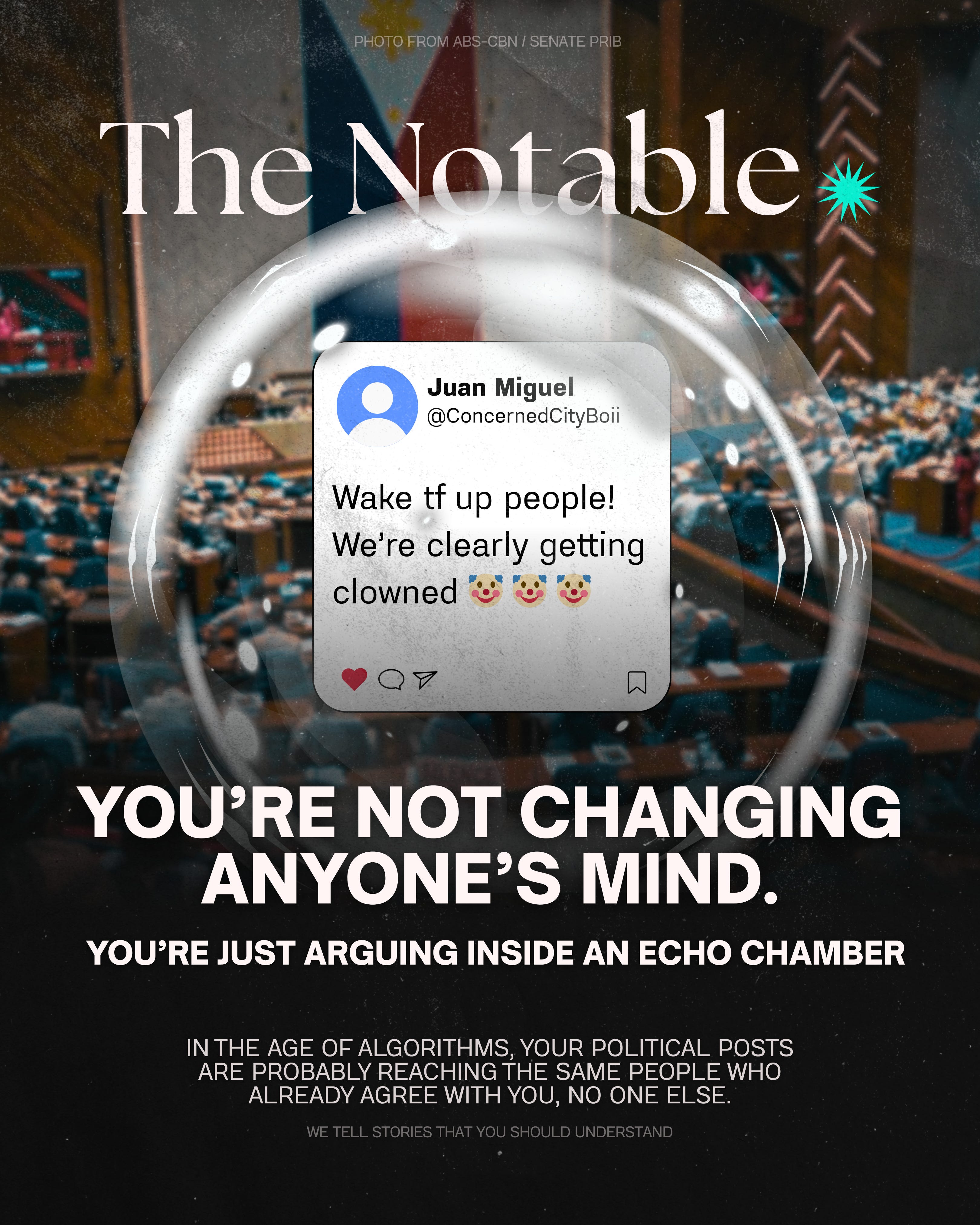
A strange realization is beginning to emerge from the political chaos unfolding online in the Philippines: the people you are trying to reach probably never saw your post.
Not the Marcos supporters. Not the Duterte loyalists. Not the politically apathetic friends you’re frustrated with. Not the people you think are still “blind.”
Just because someone is your Facebook friend does not mean the algorithm shows them your content. And that illusion matters more than most people realize.
Millions of Filipinos today believe they are participating in political persuasion when in reality, they are mostly speaking to people who already agree with them. An echo chamber. And the more emotional politics becomes, the stronger that chamber gets.
The algorithm is not designed to change minds
Most people still imagine social media as a digital public square. It is not.
Platforms do not primarily optimize for democratic dialogue, civic understanding, or truth-seeking. They optimize for engagement. The central question shaping modern social media is brutally simple: what keeps users scrolling?
And the answer is uncomfortable.
People generally prefer content that validates them emotionally. If users were constantly shown opinions they strongly disliked, many would disengage from the platform entirely. So the algorithm quietly studies human behavior. It learns what angers you, what excites you, what political content you linger on, who you tend to agree with, and which narratives reward you emotionally. Then it gives you more of that world.
Over time, your feed becomes a politically personalized reality.
That is why many Filipinos increasingly feel that “everyone around them” shares the same political views. But they do not. They are simply seeing their cluster.
The Philippine Senate Crisis Exposed This Perfectly
The recent tensions surrounding the Philippine Senate exposed this dynamic perfectly.
Depending on which online ecosystem a person belonged to, the same political events carried entirely different meanings. For some, the Senate became a symbol of democratic resistance. For others, it became an instrument of destabilization and elite warfare. Criticism of government was seen either as patriotic accountability or coordinated political demolition. The same country was watching the same events unfold while experiencing completely different emotional realities.
Social media amplified all of it because outrage performs well. Conflict performs well. Tribal loyalty performs well. Nuance does not.
This is why so many political posts online feel strangely ineffective despite appearing viral. A person writes “Wake up, Philippines,” or attacks friends for remaining silent, believing they are challenging people from the other side. But the people most likely to see those posts are usually politically aligned mutuals who already agree. The applause, shares, and reactions create the illusion of persuasion when in reality, the message often never escapes the ideological bubble it originated from.
Meanwhile, the people being criticized are trapped inside a different algorithmic environment entirely, consuming a completely different stream of emotional and political reinforcement. Both sides believe they are defending the truth. Both sides believe the public is waking up. Both sides believe the other is blind.
This is what makes the current political climate in the Philippines so volatile. The country is no longer merely divided by ideology or class or political loyalty. It is increasingly divided by information ecosystems engineered by algorithms that reward emotional reinforcement over uncomfortable exposure.
And perhaps the most unsettling part is that many of the loudest political voices online may actually be the least exposed to opposing viewpoints.
Not necessarily because they intentionally avoid them, but because the architecture itself filters disagreement out. The platform learns what keeps people emotionally engaged and gradually builds invisible walls around them.
The result is psychologically deceptive. People begin confusing visibility within their tribe for national momentum. A post receiving thousands of reactions inside one political ecosystem can feel like societal consensus even while another ecosystem, equally large and equally convinced, is seeing none of it.
The Philippines is especially vulnerable to this because politics here is deeply emotional and identity-driven. Political allegiance is often tied to family, resentment, personality, class aspiration, regional identity, and social belonging. Social media intensifies all of those impulses because emotional intensity is profitable. The platform benefits when people remain emotionally activated, tribal, reactive, and constantly engaged.
This is why social media did not simply create political division. It industrialized it.
The architecture of modern platforms rewards certainty over complexity, outrage over reflection, performance over dialogue, and tribal validation over uncomfortable understanding. What disappears in the process is the shared public space democracy once depended on. Citizens no longer merely disagree on solutions. Increasingly, they disagree on reality itself.
And perhaps that is the darkest irony of all. Many people passionately telling others to “open their eyes” are themselves trapped inside invisible algorithmic walls they cannot see.
The modern political citizen can spend years believing they are changing minds while mostly performing inside a carefully curated room full of people already clapping for them.
An echo chamber disguised as democratic participation.