


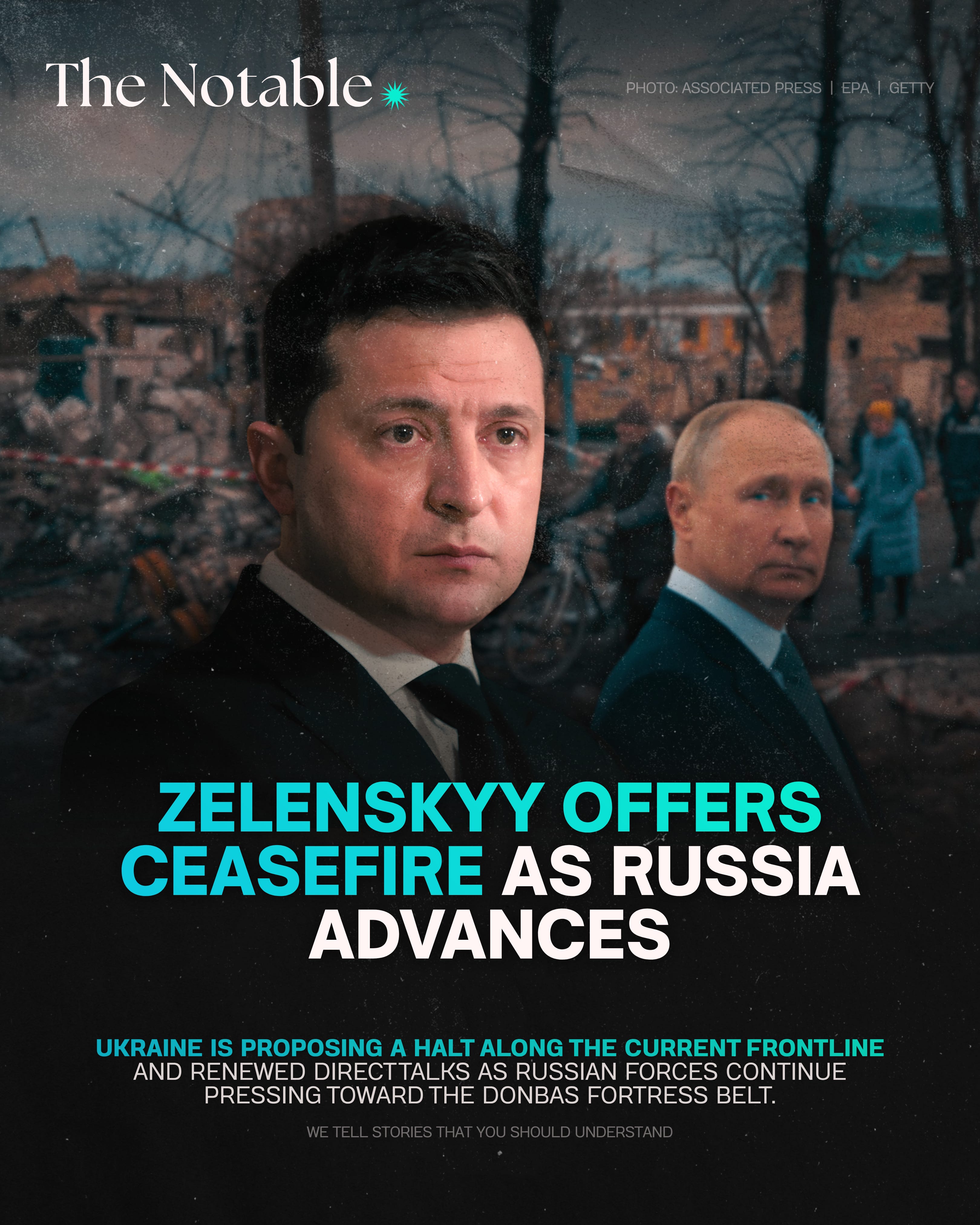
Ukrainian President Volodymyr Zelenskyy has proposed a ceasefire based on the current line of contact, alongside renewed direct negotiations with Russia.
The approach reflects a central argument Kyiv has made throughout recent diplomatic efforts: the fighting should stop before the two sides attempt to resolve the much larger political questions surrounding the war.
Zelenskyy has also advocated an end to attacks against energy infrastructure, an issue that has become particularly important as Russia has repeatedly targeted Ukraine’s electricity and heating systems.
The proposal does not mean Ukraine has accepted Russia’s territorial demands. Rather, Kyiv is seeking to use the existing battlefield position as the starting point for negotiations while preserving the possibility of a broader political settlement.
The Current Frontline Would Become the Starting Point
A ceasefire along the existing line of contact would effectively freeze the battlefield where it stands.
That distinction matters.
A ceasefire is not the same thing as a peace agreement, and freezing the frontline would not automatically settle the question of territory occupied by Russia. It would instead establish a military pause from which negotiations could proceed.
Ukraine and its European partners have previously supported using the current line of contact as the starting point for negotiations, while arguing that any final settlement must be accompanied by credible security guarantees for Kyiv.
For Ukraine, the calculation is straightforward: stop further Russian advances while creating space for diplomacy.
For Russia, accepting such an arrangement could mean giving up the opportunity to gain additional territory through continued military pressure.
Russia Has Not Accepted Kyiv’s Framework
Moscow has not accepted the ceasefire proposal on Kyiv’s terms.
The central obstacle remains the enormous gap between the two sides over what a settlement would require.
Russia has repeatedly demanded significant concessions from Ukraine, including restrictions on Ukraine’s future military and security alignment. Moscow has long opposed Ukrainian membership in NATO and has sought to limit the country’s ability to integrate militarily with the West.
Kyiv, meanwhile, has continued to seek Western military assistance, stronger sanctions against Russia and security guarantees that would prevent a ceasefire from simply becoming an opportunity for Moscow to rebuild its forces and resume the war later.
That makes the question of what happens after a ceasefire nearly as important as the ceasefire itself.
Why the Donbas Matters
The timing of Zelenskyy’s proposal is significant because Russian forces continue to apply military pressure in eastern Ukraine.
The Sloviansk-Kramatorsk area is particularly important.
Kramatorsk and Sloviansk form part of the major Ukrainian defensive belt in Donetsk oblast. Their broader area has remained a central objective of Russia’s campaign to expand its control over the Donbas.
Russian forces have continued offensive operations around the approaches to this area.
However, claims that Russian troops are definitively only five kilometers from both Kramatorsk and Sloviansk should be treated cautiously. Available battlefield assessments confirm continued Russian attacks and pressure in the broader area, but do not establish that precise five-kilometer figure as an independently verified fact.
That distinction is important because battlefield maps can change rapidly, and proximity to a city does not necessarily mean that Russian forces have broken through its defensive perimeter.
What is clear is the strategic importance of the area and the pressure Ukraine faces as Russia continues its offensive.
The NATO Question Is Becoming More Complicated
Another development from the same diplomatic environment is potentially significant.
Former Ukrainian military commander Valerii Zaluzhnyi has said he sees no realistic prospect of Ukraine joining NATO under current conditions.
That does not mean Kyiv has formally abandoned its NATO objective.
Ukraine’s constitution continues to identify membership in NATO and the European Union as strategic objectives. But the political reality is considerably more complicated.
NATO membership requires consensus among the alliance’s members, and Russia has made Ukrainian neutrality or restrictions on NATO alignment a central demand in its vision of a settlement.
The issue therefore sits directly at the heart of the negotiations.
Ukraine wants guarantees strong enough to deter another Russian invasion. Russia wants to prevent Ukraine from becoming more deeply integrated into the Western military system.
A ceasefire could stop the immediate fighting without resolving that fundamental disagreement.
Why Western Weapons Still Matter
Kyiv’s diplomatic push is happening alongside continued appeals for military support from its Western partners.
Zelenskyy has argued that Ukraine needs stronger weapons and greater pressure on Russia to create the conditions for a meaningful peace.
That strategy reflects a basic feature of the negotiations: diplomacy is being conducted under battlefield conditions.
Ukraine’s ability to resist Russian advances affects its leverage at the negotiating table. At the same time, Russia’s ability to keep advancing gives Moscow incentives to demand more favorable terms.
This creates a difficult strategic equation for Kyiv.
If Ukraine can stabilize the front, a ceasefire may preserve territory still under Ukrainian control and prevent further losses. If Russian forces continue advancing, Moscow could enter future negotiations from a stronger military position.
The Energy War
The proposed halt to energy attacks carries significance beyond Ukraine’s electricity supply.
Russia’s strikes against Ukraine’s energy infrastructure have repeatedly damaged power generation and distribution networks, particularly during periods of intense fighting.
Ukraine has also attacked Russian energy-related infrastructure during the war.
An agreement to stop such attacks could therefore represent one of the more immediately achievable forms of de-escalation.
But enforcing an energy truce would be difficult.
Both sides would need to agree on what facilities qualify as protected energy infrastructure, how violations would be verified and what consequences would follow if either side accused the other of breaking the arrangement.
That is why even a narrowly defined energy ceasefire would require mechanisms for monitoring and enforcement.
A Ceasefire Is Not Yet Peace
The most important distinction is that Zelenskyy’s proposal is a framework for stopping the fighting, not a completed peace settlement.
A ceasefire could freeze the battlefield. It could reduce civilian casualties. It could give Ukraine and Russia space to negotiate.
But it would leave several fundamental questions unresolved.
Who controls the occupied territories? What security guarantees does Ukraine receive? What happens to Ukraine’s military? What role does NATO play? Which sanctions remain in place? Who monitors the ceasefire? And what prevents either side from using the pause to prepare for another offensive?
Those questions would determine whether a ceasefire becomes the beginning of peace or simply an intermission in the war.
The Bigger Picture
After years of fighting, the diplomatic equation is increasingly shaped by a simple reality: neither side has yet secured the outcome it wants through military force alone.
Ukraine is trying to stop further territorial losses while preserving its sovereignty and Western alignment.
Russia continues to seek battlefield gains and political concessions from Kyiv.
The United States and European governments, meanwhile, face the challenge of supporting Ukraine while determining how much pressure can be applied to Moscow to accept a settlement.
That makes the current proposal significant even if Russia rejects it.
Kyiv is signaling that it is prepared to discuss a ceasefire based on the battlefield as it currently exists. But it is also making clear that stopping the war does not mean accepting Russia’s terms for Ukraine’s future.
What to Watch Next
The immediate question is whether Moscow responds with its own conditions or rejects the proposal outright.
The next major indicators will be battlefield developments around the Donbas, the level of Western military support reaching Ukraine, and whether Washington and European governments can coordinate a common negotiating position.
The most consequential issue, however, will be whether Russia and Ukraine can agree on what a ceasefire is supposed to accomplish.
If the objective is simply to stop the shooting, an agreement may be possible.
If the objective is to create the foundations for a lasting peace, the hardest questions are still ahead.